
A primer on the assessment of throwing mechanics in softball athletes — including the unique windmill pitch
Looking for guidance on overhead throwing mechanics (baseball-forward)? Click Here.
The windmill softball pitch is a vastly understudied human motion relative to its counterpart, the overhand baseball pitch. [1] Despite fastpitch softball’s growing popularity — with more than two million participants in the United States — there is comparatively limited evidence-based guidance for practitioners, coaches, and athletes. [2] Biomechanical evidence has demonstrated that the windmill pitch produces shoulder and elbow joint loads similar to those reported in baseball pitchers, challenging the long-held misconception that underhand pitching is inherently “safer”. [1] [3]
By understanding the unique demands of the softball pitch and the overhead throw used by position players, clinicians and coaches can better identify mechanical faults, prevent overuse injuries, and optimize performance.
Why Softball Deserves Its Own Page
Softball throwing encompasses two fundamentally different motions: the windmill pitch (unique to softball) and the overhead throw (used by position players, similar to baseball). Each places distinct demands on the body:
- The windmill pitch involves a full 360° circumduction of the arm, generating peak stress at ball release rather than during arm cocking (as in baseball). This creates high glenohumeral distraction forces and places significant eccentric load on the biceps-labrum complex. [4] [5]
- Position player throwing in softball is biomechanically similar to baseball throwing, but important differences exist in trunk and shoulder kinematics — likely influenced by differences in playing conditions (shorter base paths, smaller field dimensions) and sex-related anatomical factors (e.g., carrying angle of the elbow). [6] [7]
Despite these demands, softball lacks the pitch count regulations and workload monitoring infrastructure that baseball has developed. As of 2023, no established pitch count restrictions exist in most United States or Canadian softball governing bodies, even though the AOSSM has published prevention guidelines recommending maximum pitch counts. [2] [8]
Part 1: The Windmill Softball Pitch
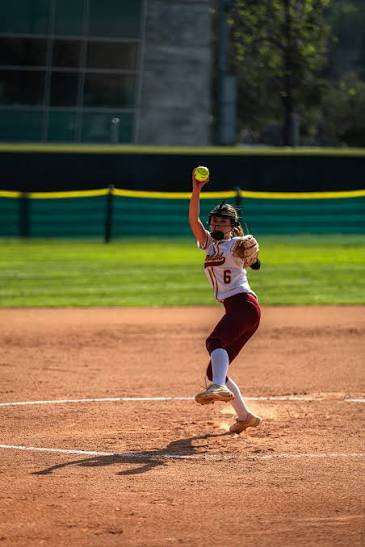
The softball pitch is a highly complex series of coordinated movements in which force generated by the large muscles of the lower extremity and trunk during the wind-up and stride phases is transferred to the ball through the shoulder and arm. [1] Unlike the overhead baseball pitch (which is typically broken into 6 phases), the windmill pitch is generally described in 4 primary phases: wind-up, stride, acceleration, and follow-through.

Understanding the “Clock” System
Because the arm travels in a full circle, softball pitching phases are often described using clock positions. [5] Imagine the pitcher standing with the pitching arm at the side (6 o’clock). As the arm rises forward and overhead, it passes through 3 o’clock (arm horizontal in front), 12 o’clock (arm overhead), 9 o’clock (arm horizontal behind/below), and back toward 6 o’clock at ball release.
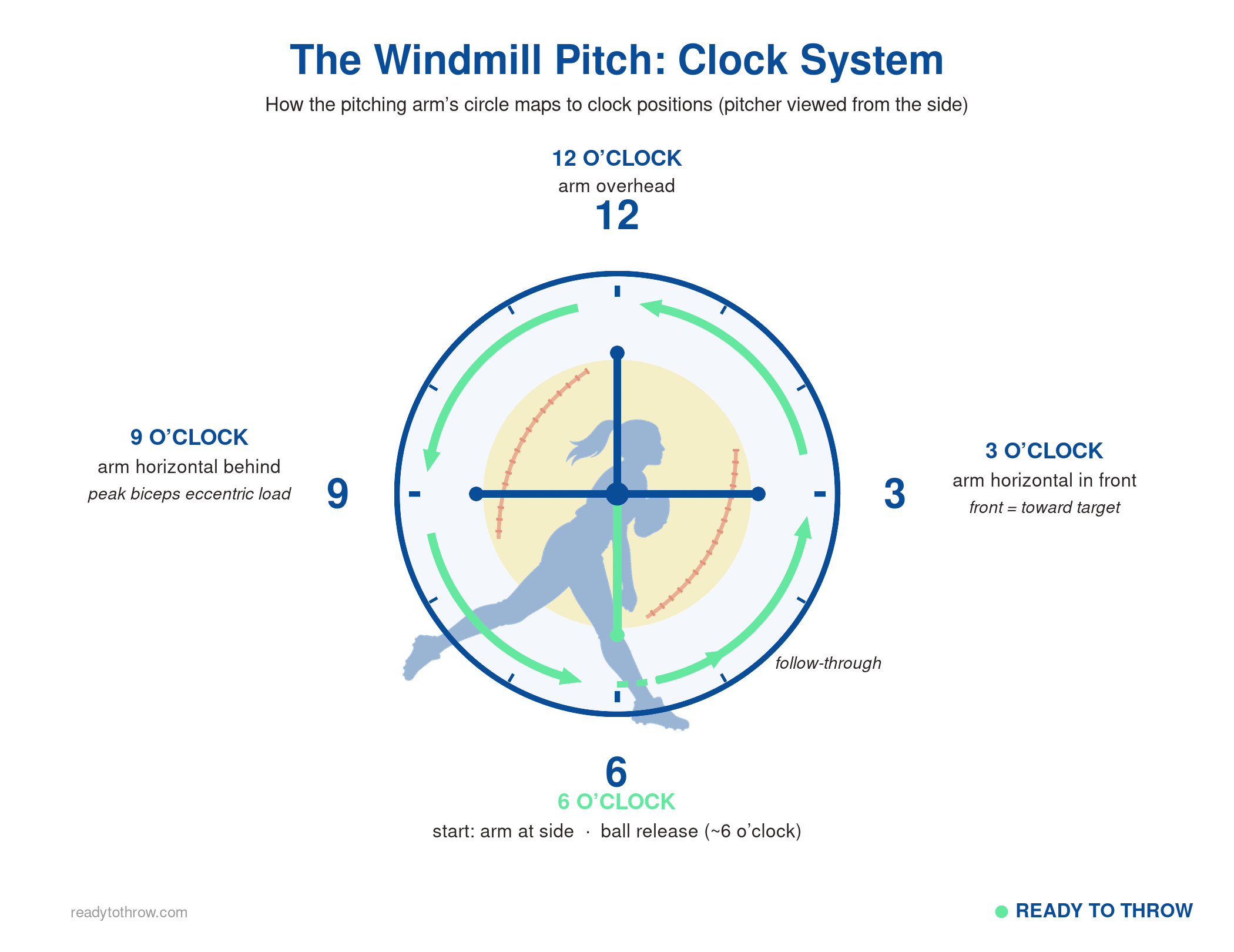
Phase-by-Phase Guide: The Windmill Pitch
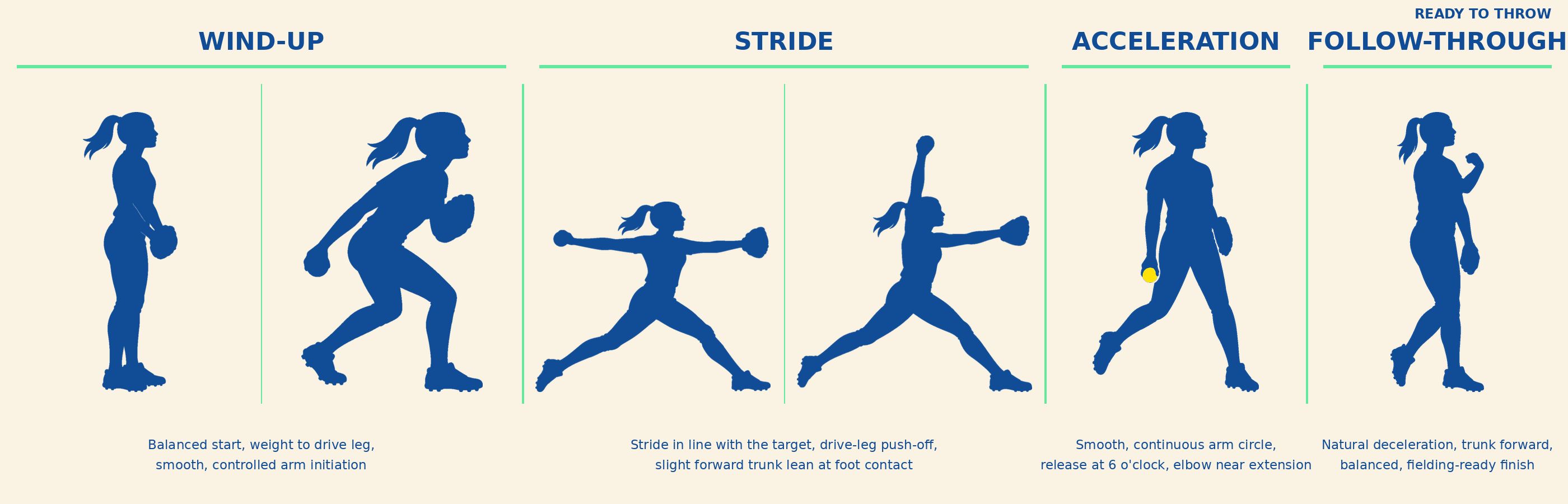
1. Wind-Up Phase
Key Focus Areas:
- Starting Position: The pitcher begins facing the batter with both feet on the pitching rubber. Observe for a balanced, athletic stance with weight evenly distributed.
- Weight Shift: The pitcher rocks back slightly, shifting weight to the drive leg. This initiates the kinetic chain from the ground up.
- Arm Initiation: The pitching arm begins its upward swing. The motion should be smooth and controlled — a rushed or jerky initiation can disrupt timing throughout the entire pitch.
- Glove-Side Arm: The glove arm should begin to move in coordination with the pitching arm, helping maintain balance and trunk alignment.
Common Faults:
- Starting with weight too far forward or backward, disrupting the timing of the stride
- Rushing the wind-up, which compresses the time available for proper sequencing
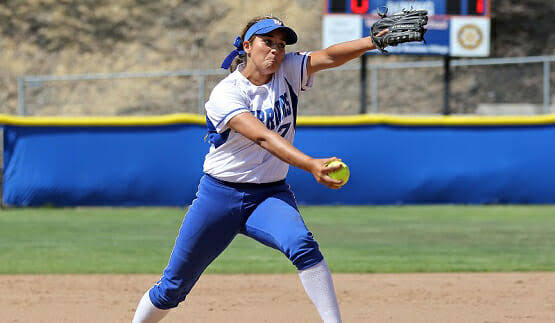
2. Stride Phase (through Stride Foot Contact)
Key Focus Areas:
- Stride Length and Direction: The stride should be directed toward the target. Stride length influences the pitcher’s ability to generate force from the lower half. Too short a stride limits ground reaction force contribution; too long a stride can cause the pitcher to “reach” and lose trunk control.
- Stride Foot Landing: The lead foot should land in line with the target. The angle and position of foot contact influence pelvic rotation and trunk mechanics.
- Trunk Position at Foot Contact: Trunk flexion at foot contact is a critical variable. Decreased trunk flexion at foot contact has been associated with increased peak shoulder distraction force (p = .005). Coaches should cue pitchers to maintain a slight forward trunk lean at landing. [9]
- Drive Leg Extension: The back leg should push off the rubber forcefully, transferring energy forward. Gluteus maximus activation is extremely high during this phase (reaching nearly 200% MVIC in some studies), underscoring the importance of lower extremity power. [10]
Common Faults:
- Insufficient trunk flexion at foot contact (associated with increased shoulder stress) [9]
- Stride direction off-line from the target
- Inadequate drive leg push-off, reducing force generation from the lower half
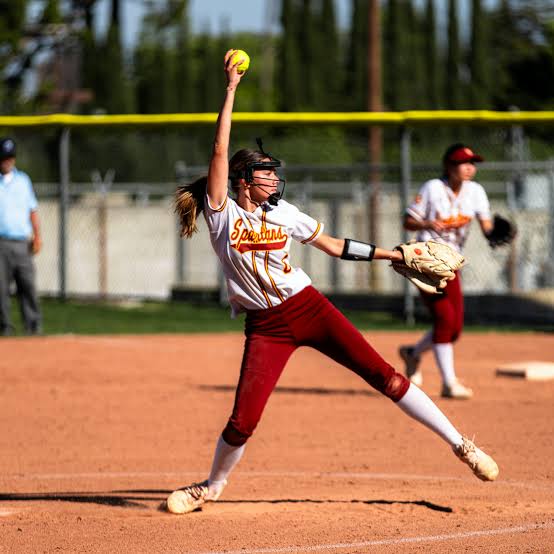
3. Acceleration Phase (through Ball Release)
Key Focus Areas:
- Arm Circle: The arm should travel in a smooth, continuous arc. As the arm passes from the 12 o’clock position downward toward ball release (approximately 6 o’clock), the pectoralis major becomes the primary accelerator. [11]
- The 9 O’Clock Position: This is a critical moment — the biceps brachii undergoes peak eccentric contraction at this phase. Biceps activity during the windmill pitch is significantly greater than during an overhand throw (approximately 38% vs. 19% of maximum muscle test, p = .02), which helps explain the high incidence of anterior shoulder pain and biceps-labrum complex injuries in windmill pitchers. [5]
- Elbow Position at Ball Release: The greatest stress to the shoulder during the windmill pitch occurs at ball release. Greater elbow flexion at ball release has been associated with greater shoulder adduction torque (r = -0.522, p = .007). The elbow carrying angle (a relatively fixed anatomical variable, often more pronounced in female athletes) also influences shoulder torques at release. [4]
- Trunk and Hip Rotation: The trunk should rotate and flex forward as the arm accelerates downward. Proper sequencing of hip rotation before trunk rotation is essential for efficient energy transfer. [1]
- Scapular Dynamics: The scapula transitions from upward rotation (during the top of the pitch) to downward rotation at ball release. The scapula maintains an anteriorly tilted and internally rotated (protracted) position throughout, serving as a dynamic stabilizer.
Common Faults:
4. Follow-Through Phase (after Ball Release)
Key Focus Areas:
- Arm Deceleration: After ball release, the arm must decelerate from high velocity. The biceps and posterior shoulder musculature work eccentrically to control this deceleration. The follow-through should be natural and unforced. [5]
- Trunk Flexion: The trunk should continue to flex forward, helping dissipate forces across the kinetic chain rather than concentrating them at the shoulder.
- Balance and Recovery: The pitcher should finish in a balanced, fielding-ready position. Loss of balance at follow-through may indicate fatigue, insufficient lower extremity strength, or mechanical inefficiency.
- Glove-Side Arm: The glove arm should tuck toward the body to assist with trunk rotation and deceleration.
Common Faults:
- Abrupt stopping of the arm rather than a smooth deceleration path
- Falling off to one side (indicates poor balance or lower extremity weakness)
- Insufficient trunk flexion, placing excessive deceleration demands on the shoulder

Common Mechanical Faults in the Windmill Pitch
Insufficient Trunk Flexion at Foot Contact
Fault: The pitcher’s trunk remains too upright at the moment the stride foot contacts the ground.
Impact: Decreased trunk flexion at foot contact is significantly associated with increased peak shoulder distraction force. [9] Pitchers with upper extremity pain also demonstrate greater shoulder horizontal abduction at foot contact and greater shoulder distraction at ball release compared to pain-free pitchers. [12]
Solution: Cue forward trunk lean during the stride. Core strengthening exercises (planks, anti-extension exercises, medicine ball throws) can improve the pitcher’s ability to maintain trunk position. Video review with freeze-frame at foot contact provides immediate visual feedback.
Excessive Elbow Flexion at Ball Release
Fault: The pitcher’s elbow is overly bent at the moment of ball release rather than being near full extension.
Impact: Greater elbow flexion at ball release is associated with greater shoulder adduction torque, increasing stress on the shoulder joint. [4] The elbow carrying angle (which tends to be greater in female athletes) compounds this effect by further influencing shoulder extension torque and forearm pronation at release. [4]
Solution: Emphasize “reaching through” the release point. Wall drills and towel drills can reinforce the feeling of near-full extension at release. Assess passive elbow extension — limitations here may need to be addressed with manual therapy or stretching.
“Pushing” vs. Whipping
Fault: The pitcher uses a rigid, muscled arm circle rather than a fluid, whip-like motion. The arm appears stiff throughout the circle.
Impact: A rigid arm circle reduces the contribution of elastic energy storage and release, forcing the shoulder musculature to work harder to generate velocity. This increases fatigue rate and overuse injury risk. [1]
Solution: Long-toss and wrist-snap drills can help develop the feel of a fluid arm circle. Emphasize relaxation of the arm during the non-acceleration portions of the circle. Towel drills focusing on the “snap” at release can reinforce proper mechanics.
Disconnected Lower Half
Fault: The pitcher fails to effectively use the drive leg and lower body to generate force, relying primarily on the arm for velocity.
Impact: When the lower body and trunk are not contributing adequately, the arm must compensate — increasing stress on the shoulder and elbow. Studies have shown profound bilateral fatigue in hip and scapular muscles after pitching a game (approximately 19% strength loss in hip muscles, 19% in scapular muscles), emphasizing how demanding the pitch is on the entire kinetic chain. [13] The isometric drive hip rotation strength ratio has been shown to independently predict peak shoulder distraction force beyond the effects of body mass and pitch velocity. [14]
Solution: Strengthen the gluteals, hip rotators, and core. Lateral plyometric drills, single-leg exercises (split squats, Bulgarian split squats, single-leg deadlifts), and medicine ball rotational throws can improve lower-half power. During pitching practice, cue aggressive push-off from the rubber.
Stride Direction Errors
Fault: The stride foot lands too far to the glove side (“closed”) or too far to the arm side (“open”) rather than in line with the target.
Impact: Off-line stride direction disrupts the kinetic chain, altering pelvic rotation and trunk mechanics. This can lead to compensatory arm patterns and inconsistent ball placement.
Solution: Use visual cues (tape lines, chalk marks) on the mound to provide immediate feedback on stride direction. Shadow pitching with a focus on foot placement can help ingrain the correct pattern.
Part 2: Overhead Throwing in Softball (Position Players)
Softball position players use an overhead throwing motion that is biomechanically similar to baseball throwing. The same phase-by-phase assessment principles outlined on the main Throwing Mechanics page apply here. However, several important distinctions warrant attention:

Key Differences from Baseball Position Players
- Field Dimensions: Softball’s shorter base paths (60 feet vs. 90 feet) and smaller field dimensions mean that throws are generally shorter but must be executed more quickly. This often leads to abbreviated wind-ups and quicker release times, which can alter mechanics.
- Throwing Styles: Softball fielders frequently adopt sidearm or three-quarter arm slots when making quick throws, particularly from the infield. These arm angles change the stress distribution across the shoulder and elbow.
- Trunk and Shoulder Kinematics: Research comparing baseball and softball catchers’ throw-down mechanics has identified significant differences in trunk flexion, trunk lateral flexion, shoulder elevation, and the plane of elevation throughout the throwing motion. These differences support the need for sport-specific biomechanical assessments rather than simply applying baseball norms to softball athletes. [6]
- Adaptive Changes: Collegiate baseball players demonstrate significantly greater glenohumeral internal rotation deficit (GIRD), total range of motion differences, and humeral retrotorsion compared to softball players. Softball position players show few differences from non-throwing female controls, suggesting that the adaptive changes seen in baseball may not apply to softball athletes. This means that stretching and strengthening programs designed for baseball may not be the most effective programs for softball athletes. [7]
Assessment Approach for Position Players
The same phase-by-phase overhead throwing assessment used for baseball applies (see main Throwing Mechanics page), with particular attention to:
- Arm slot consistency: Softball players may use multiple arm angles depending on the play. Assess whether the athlete can maintain proper mechanics across different throwing scenarios.
- Quick-release mechanics: Evaluate whether abbreviated throwing motions sacrifice proper sequencing (especially hip-shoulder separation and trunk rotation).
- Lower extremity contribution: Even on short throws, the lower half should be engaged. Watch for “all-arm” throws that bypass the kinetic chain.
Injury Patterns in Softball
Understanding the injury landscape helps contextualize why mechanics assessment matters.
Overall Epidemiology
- The overall injury rate in NCAA women’s softball is approximately 3.92 per 1,000 athlete-exposures. The injury rate is higher in college than in high school (3.19 vs. 1.16 per 1,000 AEs; IRR = 2.76). [15] [16]
- The most commonly injured body region is the shoulder (15.2%), followed by hand/wrist (11.8%), knee (11.2%), and head/face (11.2%). [15]
- Lower extremity injuries are more common overall in softball, but pitchers more often suffer upper extremity injuries. [8]
- Shoulder and elbow injury rates are higher in collegiate athletes compared to high school athletes. In high school athletes, shoulder injury rates range from 0.88 to 1.14 per 10,000 AEs, while in collegiate athletes they range from 3.76 to 5.93 per 10,000 AEs. [17]
- Most softball injuries (81–96%) allow return to sport within 3 weeks. [17]
- The proportion of shoulder and elbow injuries increases with athlete age. [18]
Pitcher-Specific Injuries
- The windmill pitch generates high glenohumeral distraction forces — shoulder distraction stress averages 94% body weight in youth pitchers — and places significant stress across the biceps-labrum complex. [2] [3] [5]
- The biceps brachii undergoes peak eccentric contraction during the 9 o’clock phase, making it particularly vulnerable to overuse injury. Peak biceps activation during the windmill pitch is approximately double that of the overhand throw (38% vs. 19% MMT, p = .02). [5]
- Common pitcher injuries include: biceps tendinopathy, SLAP tears, rotator cuff pathology, and shoulder impingement. The 2 most common shoulder injuries reported in the literature are shoulder muscle-tendon strains and shoulder/biceps tendinitis. [2] [19]
- Fatigue is a major risk factor: after pitching a game (mean ~99 pitches), significant bilateral strength loss occurs in hip muscles (~19%), scapular muscles (~19%), and shoulder muscles (~17% dominant side). [13]
- Pitchers with upper extremity pain demonstrate greater shoulder horizontal abduction at foot contact, less trunk lateral flexion toward the throwing side at ball release, and greater shoulder distraction at ball release compared to pain-free pitchers. [12]
Workload and Pitch Count Considerations
One of the most critical — and most neglected — aspects of softball pitcher health is workload management. Unlike baseball, where pitch count limits and required rest periods are well-established and enforced at most levels of play, softball has no universally enforced pitch count regulations. [2] [8]
Current Guidelines
The AOSSM, in conjunction with the National Council for Youth Sports, has published pitch count recommendations (modeled after baseball guidelines): [20]
| Age | Pitches/Game | Pitches/Day (Days 1–2) | Pitches/Day (Day 3) | References |
|---|---|---|---|---|
| 8–10 | 50 | 80 | 0 | [1] |
| 10–12 | 65 | 95 | 0 | [1] |
| 13–14 | 80 | 115 | 80 | [1] |
| 15+ | 100 | 140 | 100 | [1] |
However, these recommendations have not been adopted by most US softball governing bodies. [2]
The Problem
- Softball pitchers commonly throw more pitches per game and per season than their baseball counterparts. [4]
- Research has shown that pitchers throwing >85 pitches per game were more than twice as likely to seek medical attention for pain/injury and reported playing through pain a higher percentage of the year (49.3% vs. 25.2%, p .05). [21]
- In a study of high school varsity pitchers, 25.6% exceeded pitch count recommendations during games alone — and this increased to 51.2% when including bullpen and warm-up pitches. [22]
- Pitchers report increasing fatigue and pain over a game and across weekend tournaments. [23]
- A simulated game and doubleheader study showed significant decreases in shoulder, elbow, and wrist kinetics from the first to last inning and into the doubleheader, indicating progressive fatigue. [23]
Practical Recommendations
- Track pitch counts including warm-up and bullpen pitches, not just in-game pitches. [22]
- Monitor for signs of fatigue: declining velocity, altered mechanics, self-reported pain or fatigue. [13] [23]
- Advocate for rest between outings, especially during tournament play. [8]
- Emphasize pre-season conditioning to build the endurance base needed for competitive demands. [8]
- Core and lower extremity strengthening are essential — these muscle groups fatigue profoundly during pitching and are critical for maintaining mechanics. [13] [14]
Injury Prevention Strategies
Prevention and rehabilitation in softball should focus on several key areas: [2] [8]
1. Optimize Mechanics
- Regular video analysis of pitching and throwing mechanics (see phase-by-phase guides above)
- Address mechanical faults early, before they become ingrained patterns
- Use sport-specific assessments — do not simply apply baseball norms to softball athletes [7]
2. Strengthen the Kinetic Chain
- Core and trunk: Planks, anti-rotation presses, medicine ball rotational throws, chops/lifts
- Hips and glutes: Single-leg deadlifts, lateral band walks, split squats, hip rotation exercises. The isometric drive hip rotation strength ratio independently predicts shoulder distraction force in collegiate pitchers. [14]
- Scapular stabilizers: Serratus anterior exercises (push-up plus, wall slides), lower/middle trapezius strengthening (prone Y/T/W), rows
- Rotator cuff: Internal/external rotation strengthening at various positions, eccentric emphasis for the posterior cuff
- Biceps-specific: Given the unique eccentric demands on the biceps during the windmill pitch, include eccentric biceps strengthening (eccentric curls, slow negatives) [5]
3. Maintain Range of Motion
- Assess and maintain glenohumeral internal and external rotation
- Monitor for GIRD (though this is less common in softball than baseball) [7]
- Address hip internal rotation limitations, which can affect pitching mechanics
- Assess lumbopelvic-hip complex mobility
4. Manage Workload
- Follow available pitch count guidelines as a starting point [20]
- Account for total throwing volume (games + practice + warm-ups + bullpens) [22]
- Ensure adequate rest between pitching outings
- Implement a structured off-season with periodized training
5. Recognize Fatigue
- Educate coaches and athletes on signs of fatigue [13]
- Declining velocity, altered mechanics, and self-reported pain are red flags [23]
- Consider functional testing (grip strength, shoulder rotation strength) as objective fatigue markers [13]
- Low-cost screening measures such as isometric hip rotation strength testing can identify pitchers at risk for high shoulder distraction forces [14]
Tips for Effective Slow-Motion Analysis of the Windmill Pitch
- Use Multiple Angles: Capture video from the side (perpendicular to the pitching line), behind the pitcher, and from the front. The side view is most critical for assessing the arm circle, trunk flexion, and stride length.
- Key Freeze-Frame Points: Stop the video at (1) top of the arm circle (12 o’clock), (2) stride foot contact, (3) 9 o’clock position, and (4) ball release. These four time points capture the most clinically relevant positions.
- Compare Across Pitch Types: Mechanics may vary between the fastball, drop ball, curveball, and changeup. Assess each pitch type separately, as different pitches produce different kinetic profiles. [23]
- Track Changes Over Time: Regularly capture and compare video to monitor for mechanical drift, especially as fatigue accumulates during a season.
- Compare to Healthy Baseline: If possible, capture baseline video when the pitcher is healthy and fresh. This provides a reference point for identifying fatigue-related or injury-related mechanical changes.
Key Takeaways
- The windmill softball pitch generates shoulder and elbow loads comparable to the overhand baseball pitch — it is not inherently “safer”. [1] [3]
- The biceps-labrum complex is uniquely stressed during the windmill pitch due to high eccentric biceps activation, particularly at the 9 o’clock position. [5]
- Trunk flexion at foot contact, elbow position at ball release, and lower extremity engagement are critical coachable variables that influence injury risk. [4] [9] [14]
- Softball position players throw overhead similarly to baseball players, but demonstrate different adaptive changes — sport-specific assessment and training programs are warranted. [6] [7]
- Workload management is the most significant gap in softball injury prevention. Pitch counts should be tracked and rest periods enforced, even in the absence of league mandates. [2] [21] [22]
- Core, hip, and scapular strengthening are foundational to both injury prevention and performance enhancement in all softball athletes. [8] [13]
References
- Fry KE, Wittman K, Gerke D, Parr A. Clinical and Biomechanical Evaluation of the Softball Pitcher: A Review of Current Concepts and Clinical Commentary. Clinical Journal of Sport Medicine. 2019;29(5):406-412. doi:10.1097/JSM.0000000000000692.
- Boden SA, Arner JW, Bradley JP. Understanding Shoulder and Elbow Injuries in the Windmill Softball Pitcher. The Journal of the American Academy of Orthopaedic Surgeons. 2024;32(2):e53-e62. doi:10.5435/JAAOS-D-22-00944.
- Werner SL, Guido JA, McNeice RP, et al. Biomechanics of Youth Windmill Softball Pitching. The American Journal of Sports Medicine. 2005;33(4):552-60. doi:10.1177/0363546504269253.
- Scarborough DM, McCunney RC, Berkson EM, Oh LS. The Relationship of Elbow Alignment and Kinematics on Shoulder Torque During the Softball Pitch: A Biomechanical Analysis of Female Softball Pitchers. Journal of Shoulder and Elbow Surgery. 2019;28(2):357-364. doi:10.1016/j.jse.2018.07.021.
- Rojas IL, Provencher MT, Bhatia S, et al. Biceps Activity During Windmill Softball Pitching: Injury Implications and Comparison With Overhand Throwing. The American Journal of Sports Medicine. 2009;37(3):558-65. doi:10.1177/0363546508328105.
- Zappa R, Fava A, Lozowski B, Kohler E, Oliver GD. Kinematic Comparison of Throw-Down Mechanics Between Baseball and Softball Catchers. International Journal of Sports Medicine. 2025. doi:10.1055/a-2707-5229.
- Hibberd EE, Oyama S, Tatman J, Myers JB. Dominant-Limb Range-of-Motion and Humeral-Retrotorsion Adaptation in Collegiate Baseball and Softball Position Players. Journal of Athletic Training. 2014 Jul-Aug;49(4):507-13. doi:10.4085/1062-6050-49.3.23.
- Feeley BT, Feeley SE, Chambers CC. Fastpitch Softball Injuries: Epidemiology, Biomechanics, and Injury Prevention. Current Reviews in Musculoskeletal Medicine. 2024;17(4):110-116. doi:10.1007/s12178-024-09886-y.
- Friesen KB, Saper MG, Oliver GD. Biomechanics Related to Increased Softball Pitcher Shoulder Stress: Implications for Injury Prevention. The American Journal of Sports Medicine. 2022;50(1):216-223. doi:10.1177/03635465211055141.
- Oliver GD, Plummer HA, Keeley DW. Muscle Activation Patterns of the Upper and Lower Extremity During the Windmill Softball Pitch. Journal of Strength and Conditioning Research. 2011;25(6):1653-8. doi:10.1519/JSC.0b013e3181db9d4f.
- Maffet MW, Jobe FW, Pink MM, Brault J, Mathiyakom W. Shoulder Muscle Firing Patterns During the Windmill Softball Pitch. The American Journal of Sports Medicine. 1997 May-Jun;25(3):369-74. doi:10.1177/036354659702500317.
- Oliver GD, Gilmer GG, Anz AW, et al. Upper Extremity Pain and Pitching Mechanics in National Collegiate Athletic Association (NCAA) Division I Softball. International Journal of Sports Medicine. 2018;39(12):929-935. doi:10.1055/a-0658-1546.
- Corben JS, Cerrone SA, Soviero JE, et al. Performance Demands in Softball Pitching: A Comprehensive Muscle Fatigue Study. The American Journal of Sports Medicine. 2015;43(8):2035-41. doi:10.1177/0363546515588179.
- Ulman SM, Nebel AR, Bordelon NM, Oliver GD. Low-Cost Lower Extremity Screening to Predict Shoulder Distraction Force in College Softball Pitchers. The American Journal of Sports Medicine. 2025;53(3):565-570. doi:10.1177/03635465241310243.
- Veillard KL, Boltz AJ, Robison HJ, et al. Epidemiology of Injuries in National Collegiate Athletic Association Women’s Softball: 2014-2015 Through 2018-2019. Journal of Athletic Training. 2021;56(7):734-741. doi:10.4085/1062-6050-668-20.
- Wasserman EB, Register-Mihalik JK, Sauers EL, et al. The First Decade of Web-Based Sports Injury Surveillance: Descriptive Epidemiology of Injuries in US High School Girls’ Softball (2005-2006 Through 2013-2014) and National Collegiate Athletic Association Women’s Softball (2004-2005 Through 2013-2014). Journal of Athletic Training. 2019;54(2):212-225. doi:10.4085/1062-6050-206-17.
- Enata NM, Inclan PM, Brophy RH, Knapik D, Smith MV. The Incidence of Shoulder and Elbow Injuries in High School and Collegiate Softball Athletes: A Systematic Review. Sports Health. 2025 May-Jun;17(3):474-483. doi:10.1177/19417381241280643.
- Lee A, Farooqi AS, Talwar D, Maguire KJ. Pediatric Softball Injuries Presenting to Emergency Departments. Pediatric Emergency Care. 2022;38(7):e1365-e1368. doi:10.1097/PEC.0000000000002754.
- Como M, Fatora G, Boden SA, et al. Shoulder Injury Incidence and Epidemiology in Youth, High School, and Collegiate Fastpitch Softball Players: A Systematic Review and Future Research Perspectives. Sports Health. 2025;17(4):759-765. doi:10.1177/19417381241276018.
- Herring SA, Kibler WB, Putukian M, et al. Mass Participation and Tournament Event Management for the Team Physician: A Consensus Statement (2022 Update). Medicine and Science in Sports and Exercise. 2024;56(4):575-589. doi:10.1249/MSS.0000000000003325.
- Gooch B, Lambert BS, Goble H, McCulloch PC, Hedt C. Relationship Between Pitch Volume and Subjective Report of Injury in High School Female Fast-Pitch Softball Pitchers. Sports Health. 2022 Sep-Oct;14(5):702-709. doi:10.1177/19417381211051381.
- Kamarajugadda S, Pazik M, Horodyski M, et al. Pitch Counts and Overuse in High School Softball Pitchers: A Pilot Study Encompassing Bullpen, Warm-Up, and Game Pitches. The Journal of Sports Medicine and Physical Fitness. 2025. doi:10.23736/S0022-4707.25.16806-0.
- Fava AW, Downs Talmage JL, van Hogerwou T, Oliver GD. Effects of a Simulated Game and Doubleheader Inning on Peak Kinetics in Softball Pitching Across Pitch Types. The American Journal of Sports Medicine. 2024;52(12):3118-3129. doi:10.1177/03635465241278359.
In need of some help? Looking for a professional throwing mechanics analysis?
Let our experts handle it.
Our team is here to help you perfect your form, prevent injuries, and maximize your performance. Whether you’re a seasoned athlete or just starting, a professional throwing mechanics analysis can provide the insights you need to excel.
Click the button to learn more and fill out our request form and get started on your journey to better mechanics and enhanced performance today!